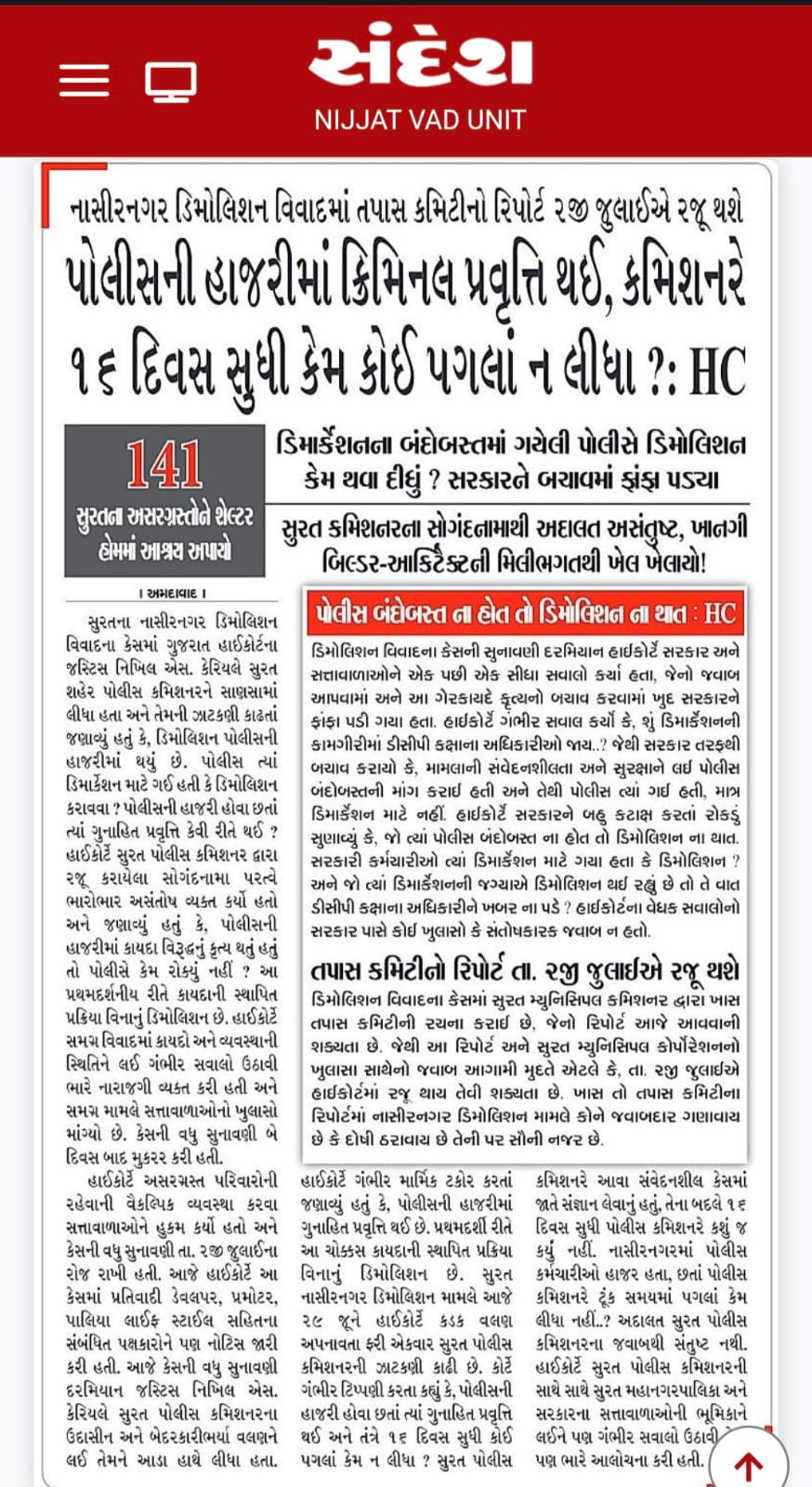
The Question the Commissioner Could Not Answer
When the Gujarat High Court summoned the Surat Police Commissioner to appear and explain why police officers who were physically present during the Nasirnagar demolition failed to intervene, the question being posed was not merely procedural. It was a question about what the police in Gujarat are actually for — and whose interests they protect.
Recap: What Happened in Nasirnagar
As reported in the earlier Sandesh investigation of June 25, the Nasirnagar locality demolition was carried out without legal notice and without a court order, rendering over 100 families homeless. Police officers were present throughout. Not one intervened. Not one filed a report. Not one filed even an informal complaint or inquiry note in their daily diary.
The Gujarat High Court had already flagged the demolition as a probable case of administrative collusion. This follow-up report concerns the next critical stage: the Court’s examination of the police chain of command.
Sixteen Days of Silence
What the High Court found, upon examination of the police records submitted, was arguably more disturbing than the demolition itself: for 16 days after the event, not a single officer in Surat city’s police chain of command — from the beat constables present at the site up to the Commissioner himself — had initiated any action, complaint, or inquiry.
No FIR had been registered. No preliminary inquiry had been opened. No report had been sent upwards through the administrative hierarchy. The Commissioner’s office, upon specific questioning, confirmed that it had been aware of the incident through media reports within 48 hours — but had taken no action even after becoming aware.
The Court’s Direct Questions
The High Court’s bench put specific questions to the police:
- Under what authority did the police officers at the site determine that their duty was to observe rather than intervene in what appeared to be a violation of the rights of private residents?
- Was any order given to police personnel not to intervene, and if so, by whom and in what form?
- Why, in the 16 days between the demolition and the Court’s initial summons, had no officer in the chain of command found it appropriate to initiate any proceeding?
The Commissioner’s answers, as summarised in the Court’s subsequent order, were characterised as “unsatisfactory and evasive.” The Court directed the submission of a detailed affidavit within 10 days addressing each question specifically.
Accountability at the Highest Level
The significance of summoning a Police Commissioner to personally explain an omission — rather than receiving a written response from a junior officer — cannot be understated in the context of Gujarat’s law enforcement culture. Such summons are rare and carry considerable institutional weight.
Suketu Shah’s continuous tracking of this story — from the night of the demolition through the initial High Court petition, the administrative response, and now the police accountability proceedings — represents the kind of sustained legal beat journalism that has defined his work at Sandesh: following a story not just through its news peak, but through every stage of institutional consequence.