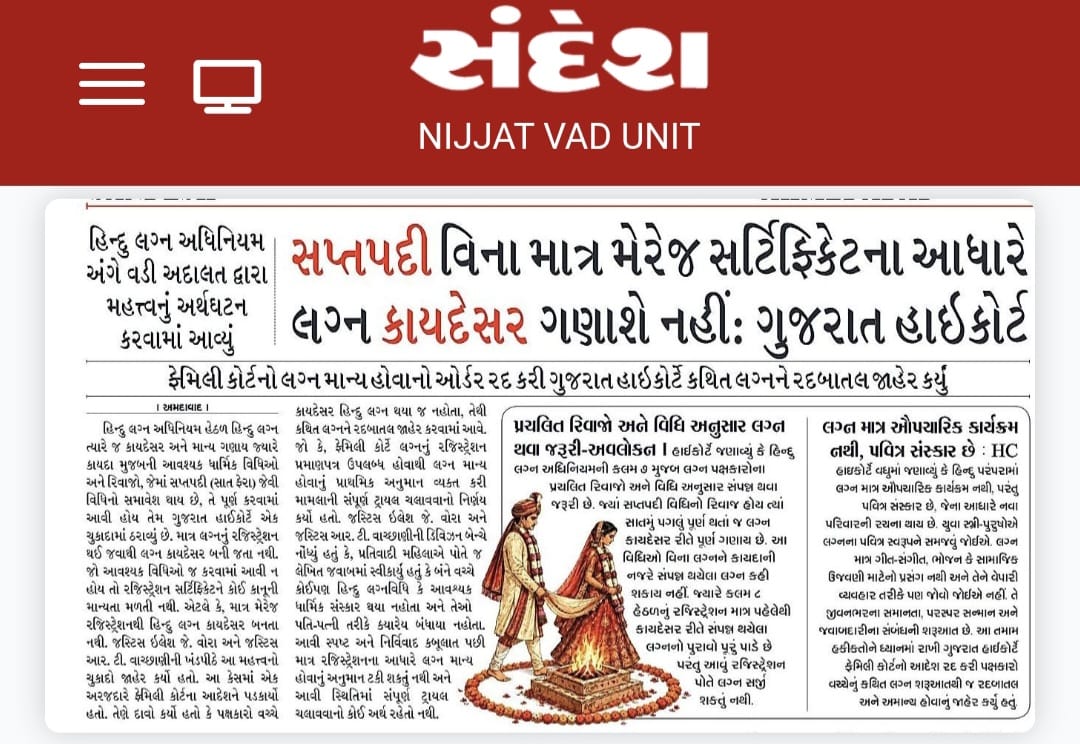
A Ruling That Reaffirms the Essentials of Hindu Marriage
In a significant ruling that has implications for thousands of marriage registrations across Gujarat and potentially across India, the Gujarat High Court set aside a Family Court order that had held a disputed marriage to be valid solely on the basis of a marriage registration certificate. The High Court held that for a Hindu marriage, the registration certificate is merely evidence — not the source — of a valid marriage, and that the Saptapadi ceremony remains an essential, irreplaceable element under the Hindu Marriage Act, 1955.
Background of the Dispute
The case arose from a matrimonial dispute in which one party contended that a valid marriage had been solemnised and produced a registered marriage certificate as evidence. The opposing party contended that no actual ceremony had taken place — specifically, that the Saptapadi (the seven steps around the sacred fire, which is the constitutive ritual of a Hindu marriage under Section 7 of the Hindu Marriage Act) had never been performed.
The Family Court had ruled in favour of the party producing the certificate, holding that the registration was conclusive proof of the marriage. This order was challenged before the High Court.
The High Court’s Legal Reasoning
The Gujarat High Court, in its detailed and lucidly reasoned judgment, traced the history of Section 7 of the Hindu Marriage Act and the established line of Supreme Court decisions on what constitutes a valid Hindu marriage. The Court held:
The Saptapadi is not optional. Section 7(2) of the Hindu Marriage Act expressly states that “where such rites and ceremonies include the Saptapadi, the marriage becomes complete and binding when the seventh step is taken.” The Supreme Court, in a series of decisions beginning with Bhaurao Shankar Lokhande v. State of Maharashtra, has consistently held that a Hindu marriage without the performance of the essential ceremonies is void, not merely voidable.
A registration certificate does not create a marriage. The Hindu Marriage Act provides for the registration of marriages (Section 8), but the registration is for the purpose of maintaining a record of marriages already solemnised, not for the purpose of creating a marriage. A certificate of registration creates an evidentiary presumption — not a legal reality — of a valid marriage. That presumption can be rebutted.
The burden of proof. Where the performance of the essential ceremonies is disputed, the burden of proving that the ceremony was performed rests on the party asserting the validity of the marriage.
Significance for Registration Practices
This ruling has significant implications for the common practice — particularly prevalent in urban Gujarat — of couples obtaining marriage registrations through affidavit-based procedures without evidence of the actual performance of the Saptapadi. The judgment does not invalidate all registered marriages, but it clarifies that the certificate alone provides no protection if the ceremony itself is later disputed.
Several family law practitioners interviewed by Suketu Shah for this report noted that the ruling is likely to be challenged before the Supreme Court, but until then, it constitutes binding precedent within Gujarat, and will have immediate impact on matrimonial litigation currently before the Family Courts of Ahmedabad, Surat, Vadodara, and Rajkot.