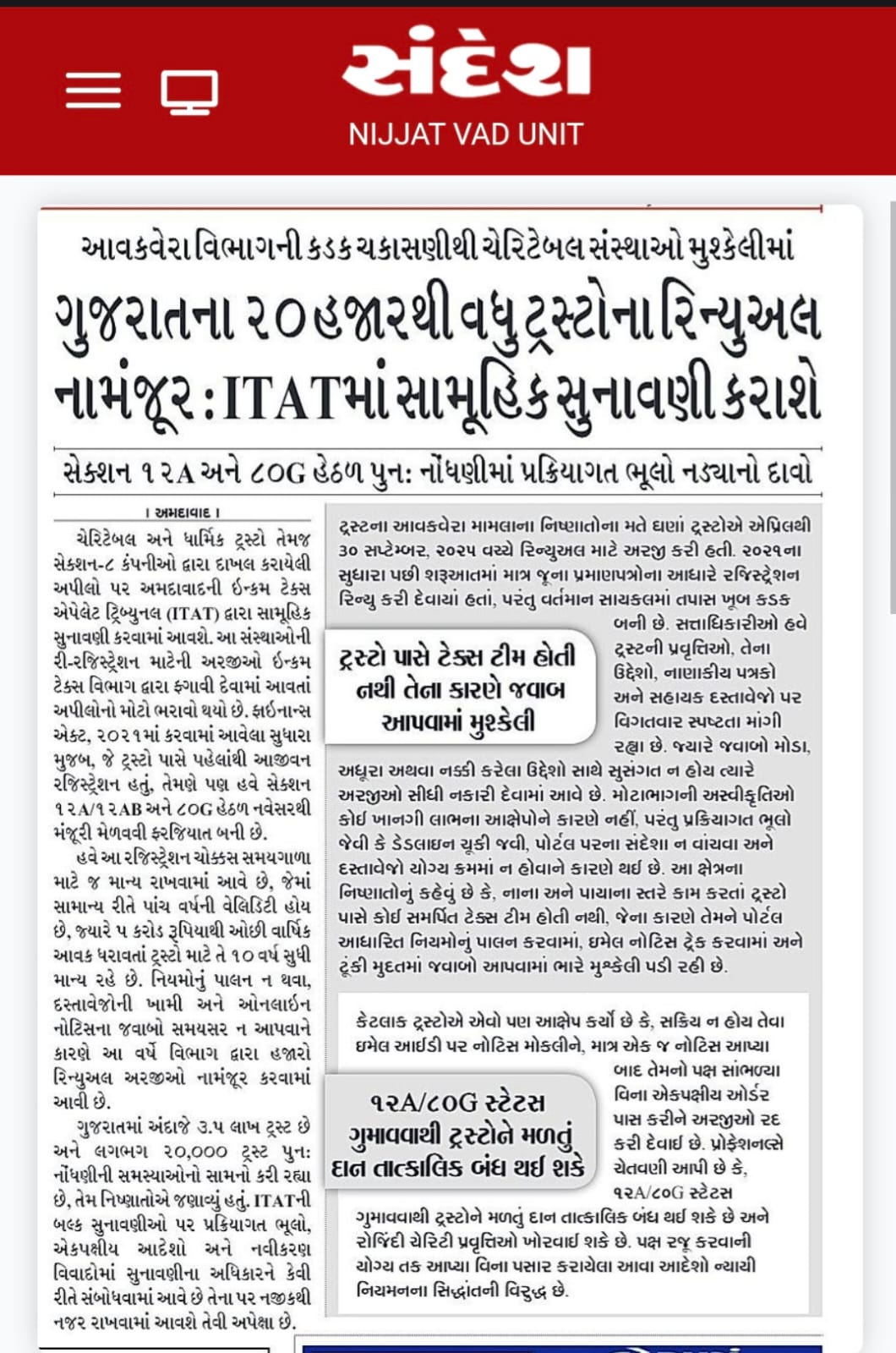
A Silent Administrative Crisis
Across Gujarat, more than 20,000 charitable and religious trusts — including schools, hospitals, temples, dharamshalas, and social welfare organisations — found themselves in legal limbo following a wave of renewal rejections by the Income Tax Department under the revised framework for Sections 12A and 80G of the Income Tax Act.
The rejections, mostly issued between January and April 2026, were largely procedural in nature — citing technical deficiencies in application filings — but the consequences were anything but technical. Trusts without active 12A registration cannot legally receive donations on a tax-exempt basis, effectively cutting off their primary funding streams. Those without 80G certification cannot provide donors the benefit of income tax deductions, making them unattractive for corporate and individual philanthropy.
The Scale of the Problem
Sandesh’s investigation, based on data obtained through RTI applications to the Income Tax Department’s Ahmedabad and Surat regional offices, established that:
- Over 20,000 renewal applications filed in the July–September 2025 window had been rejected by February 2026
- The majority of rejections cited technical grounds — mismatches in PAN registration details, incomplete activity reports, or procedural delays in submission
- Fewer than 3% of rejected trusts had received a show-cause notice prior to rejection, despite the established legal principle that quasi-judicial decisions require natural justice
- Many trusts were unaware of their rejection status until their donations began being flagged by bank compliance systems
The Ground Reality
On the ground, Suketu Shah’s reporting documented the human impact of these rejections on organisations that serve the most vulnerable. A medical charitable trust in Ahmedabad’s old city that had been providing free medicines to Below Poverty Line patients for 34 years found its donation receipts being refused by donors’ tax advisors. A mid-day meal programme run by a social welfare NGO in Vadodara faced a funding shortfall of over ₹15 lakh in the two months following its rejection — leading to a temporary reduction in meal coverage for nearly 800 schoolchildren.
Legal Challenges and High Court Intervention
Several trusts, represented by tax lawyers, moved the Gujarat High Court challenging the validity of the rejection orders. The Court, in a significant interim order, held that the rejection of 12A/80G applications without opportunity of being heard was prima facie violative of natural justice principles established in numerous Supreme Court precedents.
The bench directed the Income Tax Department to constitute a special grievance redressal mechanism and to process all pending objections within 90 days. As of the date of publication, several hundred trusts had availed of the mechanism, though the pace of redressal remained a continuing concern.
Policy Implications
This investigation highlighted a systemic tension between the Income Tax Department’s push towards a digitally streamlined compliance architecture — which demands precise adherence to new procedural requirements — and the reality of thousands of small, volunteer-run charitable organisations that lack the administrative infrastructure to navigate complex digital compliance frameworks. The story prompted responses from three Gujarat MLAs who raised the matter in the state Assembly’s question hour.