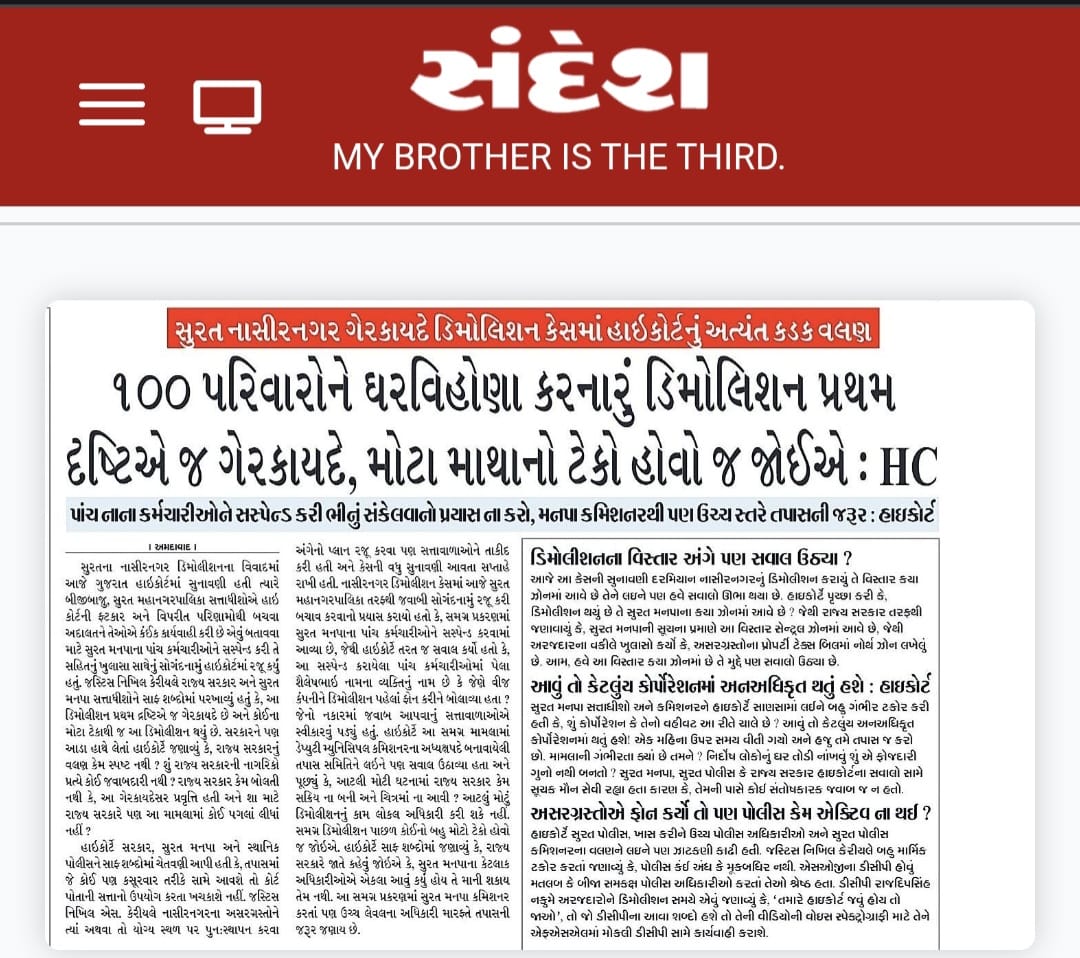
A Neighbourhood Erased Overnight
In the early hours of a June morning, the residents of Nasirnagar locality in Surat woke to the sound of demolition machinery. Within hours, over 100 families — including the elderly, children, and daily-wage workers who had lived in the settlement for upward of two decades — found themselves standing on rubble where their homes had stood. No prior notice had been served. No court order had been obtained. The demolition proceeded with the active presence of Surat Municipal Corporation personnel and, crucially, with local police watching without intervening.
The Sequence of Events
Sandesh’s investigation, which began with ground reporting from Nasirnagar within 24 hours of the demolition, established a damning sequence of facts:
No legal notice issued. The residents had received no eviction notice, no municipal notice of encroachment, and no order from a civil court. Under the settled principles of Indian administrative law, no demolition affecting residential habitation can be carried out without prior notice and an opportunity to be heard.
Police inaction was deliberate. Multiple residents stated that when they approached the police personnel present and asked for the demolition to be stopped, the officers told them to “speak with the Corporation.” The police took no action to halt proceedings despite having the authority to do so under Section 144 of the CrPC had there been a law and order situation, or to simply report the matter to their superiors.
The Corporation’s defence was contradicted by its own files. When the municipality subsequently filed an affidavit in the High Court claiming the demolition was carried out against illegal encroachments, Sandesh obtained RTI disclosures showing that the property tax records of three of the demolished buildings showed payments made to the Corporation — casting serious doubt on the “encroachment” characterisation.
The High Court’s Observations
The Gujarat High Court, hearing a public interest petition filed by two of the displaced families, observed in its interim order:
“What we have before us is a situation where over a hundred families have been rendered homeless without notice, without due process, and in the presence of law enforcement officers who chose not to intervene. This Court finds prima facie that the sequence of events points to coordination at levels above those typically responsible for routine demolition operations.”
The Court directed that an inquiry be conducted by an officer not below the rank of Additional Chief Secretary — pointedly specifying that the inquiry could not be headed by anyone within the Surat Municipal Commissioner’s administrative chain, given the suspected institutional involvement.
Accountability and the Displaced
By the time the High Court issued its interim order, most of the 100-plus families had been living in temporary shelters or with relatives for weeks. A supplementary order directed the State to arrange transit accommodation within seven days — an order that itself required a follow-up court hearing before it was partially complied with.
This story exemplifies the intersection of urban governance failures, displacement of the urban poor, and the role of judicial oversight that has characterised much of Suketu Shah’s reporting on public administration in Gujarat.