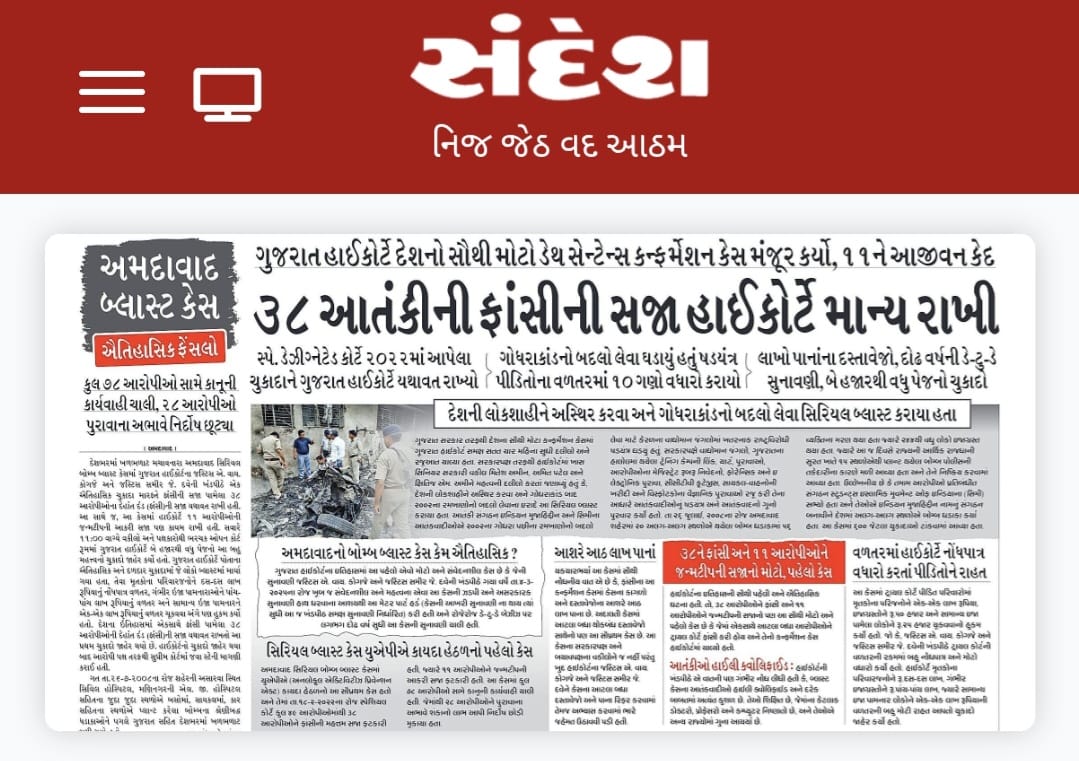
A Verdict Without Precedent in Indian Legal History
On July 5, 2026, the Gujarat High Court confirmed the death sentences of 38 individuals convicted in connection with the 2008 Ahmedabad serial bomb blasts — making it the single largest confirmation of capital punishment by a High Court in India’s post-Independence history. The ruling followed a marathon hearing process that stretched across hundreds of court days and involved legal arguments of extraordinary complexity.
The Special Court’s Original Sentencing
The Special Court established under the National Investigation Agency Act had, in its original judgment in 2022, sentenced 49 of the 78 accused to death and 11 others to life imprisonment. The remaining 18 accused were acquitted. The High Court was called upon to both confirm the death sentences (as is mandatory under Indian law for capital punishment) and hear the appeals filed by the convicted persons.
The High Court’s Scrutiny
Over nearly three years of hearing, the High Court’s bench re-examined the complete body of evidence including:
- Electronic surveillance records — call data records, intercepted communications, and device extraction data running to thousands of pages
- Forensic evidence — explosive residue analysis, blast impact mapping, and evidence linking specific accused to the manufacture and planting of devices
- Protected witness testimonies — 14 witnesses who testified under the Special Measures for Protection of Witnesses framework
- Financial trails — hawala transaction records and funding flows traced to external organisations
Sentences Confirmed and Modified
After exhaustive review, the High Court confirmed the death sentences of 38 of the 49 individuals sentenced to death by the Special Court. For 11 individuals, the Court commuted the sentence to life imprisonment on grounds of varying degrees of involvement. The acquittals of the 18 accused persons were upheld.
The Significance of “Rarest of Rare”
Indian law restricts the application of the death penalty to cases that qualify as “rarest of rare” — a standard established by the Supreme Court in Bachan Singh v. State of Punjab. The Gujarat High Court’s detailed findings held that the Ahmedabad blasts — given their deliberate targeting of hospitals, the scale of casualties, and the stated intent to destabilise the democratic order — met this threshold conclusively.
The ruling also addressed the question of reformability of the accused, finding that the ideological nature of the conspiracy and the evidence of continued intent made the possibility of reformation remote.
Reporting Through the Decades
Suketu Shah was present in the Special Court press gallery for the original sentencing in 2022 and returned to report on the High Court hearings at each critical stage. This particular story — the confirmation of death sentences for 38 individuals — represents one of the most significant single verdicts he has reported in his career. The combination of legal complexity, the scale of human tragedy, and the national implications of the ruling demanded sustained, careful, and factually precise journalism across the years.