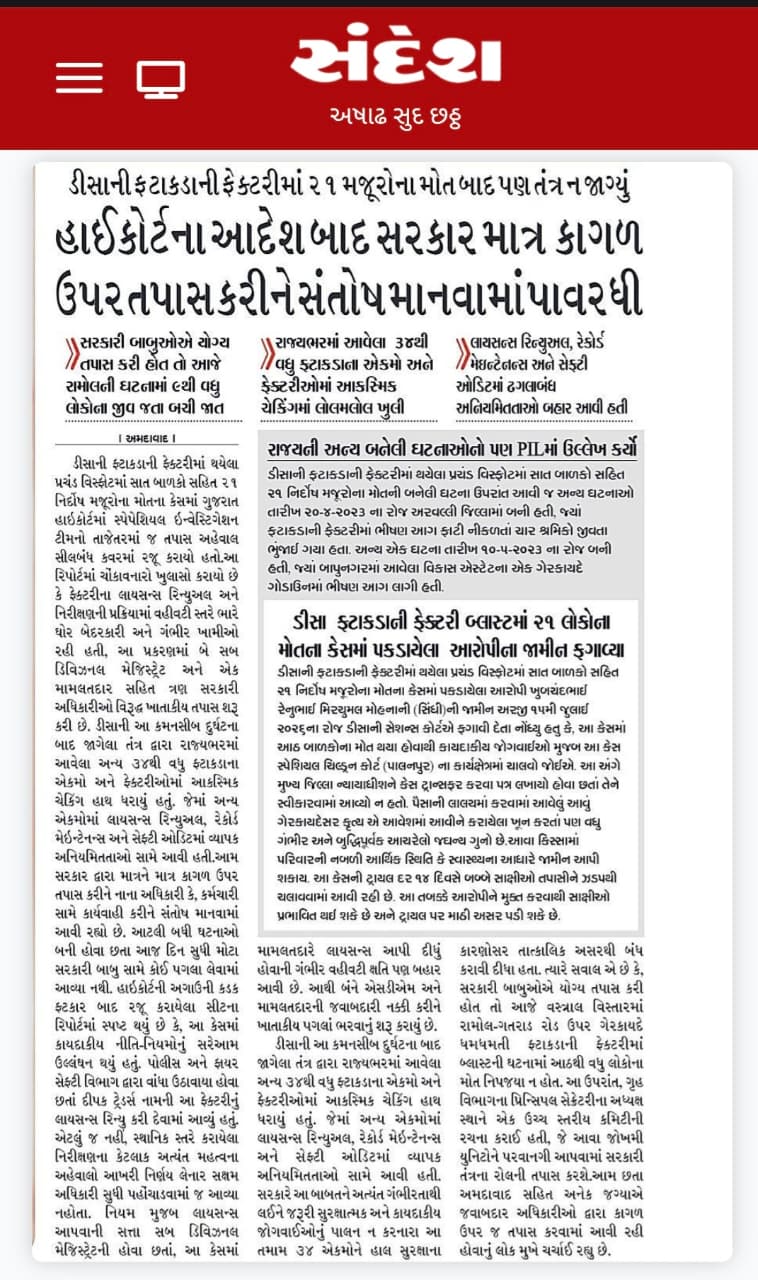
The Blast That Should Never Have Happened
When the Deesa firecracker factory exploded in the early hours of a working day, 21 men and women who had reported to work to earn their daily wages never came home. The explosion, caused by the illegal stockpiling of raw explosive material in unsafe storage conditions, was a tragedy that investigators and court proceedings would later confirm was entirely preventable.
A Factory That Should Have Been Closed
The factory in question had been flagged in multiple routine inspections over the preceding three years. Inspection reports filed by the district administration noted irregular storage practices, inadequate ventilation in the chemical mixing rooms, and the presence of unlicensed quantities of sulfur and potassium nitrate — all core indicators of a serious fire hazard. Despite these red flags appearing in official records, no action was taken to either rectify the violations or suspend operations.
The High Court Steps In
The Gujarat High Court, taking suo motu cognizance of the matter after detailed reporting in Sandesh, found that the state government’s inquiry report — submitted within a suspiciously short 18-day window — failed to address any of the substantive safety violations that had been documented prior to the blast.
The Court observed: “The inquiry report before us reads not as a genuine investigation into the causes of a disaster but as an exercise in paperwork designed to close a file. Twenty-one lives cannot be closed by paperwork.”
The bench directed the state to constitute a fresh inquiry committee headed by a retired High Court judge, with specific terms of reference covering the accountability of inspecting officers, the role of factory management, and the chain of licence approvals.
The Human Cost
Suketu Shah’s ground reporting from Deesa in the immediate aftermath of the blast documented the conditions the workers had operated in — cramped mixing rooms with no safety gear, night shifts conducted with open-flame lighting, and a management culture where workers were discouraged from raising safety complaints for fear of dismissal.
The families of the deceased, most of whom were daily-wage labourers from the surrounding villages, received no ex gratia payment in the first three months following the blast. The Sandesh investigation into the delay in compensation payments drew the attention of the Social Justice Committee of the Gujarat Legislature, which subsequently summoned district officials for explanation.
Accountability Demanded
The High Court’s order placed accountability squarely on the shoulders of the factory’s licensed operators, the district-level officials responsible for routine inspections, and the department head who had certified the inspection reports as satisfactory. Legal proceedings against the factory management were initiated in the sessions court within weeks of the High Court’s directive.
This investigation represents the kind of accountability journalism that Suketu Shah has practised across his career — starting from field reporting of a tragedy, following the institutional response, and tracking the legal proceedings through to outcome.