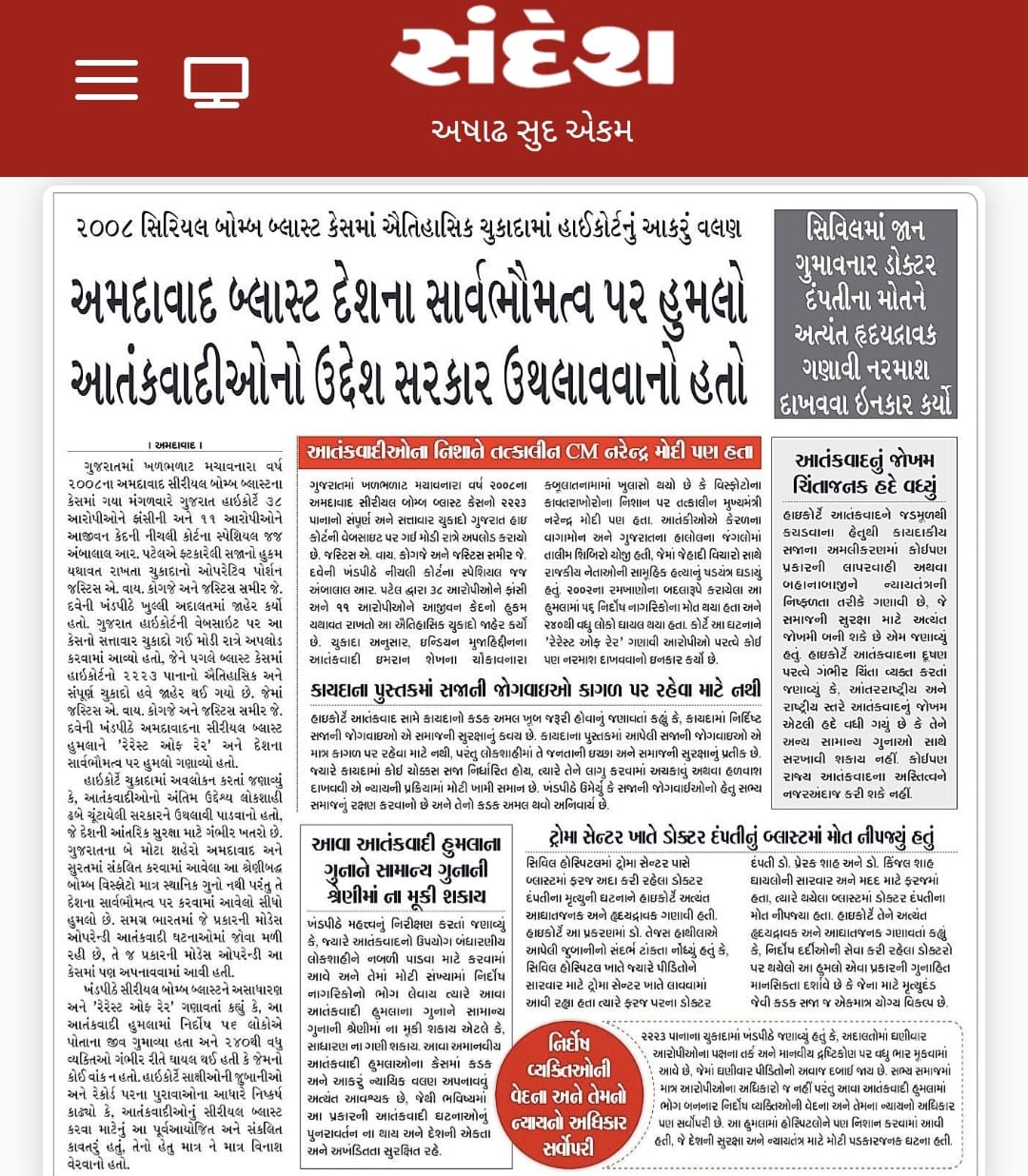
The Verdict That Shook Gujarat
On July 2, 2026, the Gujarat High Court delivered one of its most consequential verdicts in recent history, pronouncing judgment on the 2008 Ahmedabad serial bomb blasts — a case that had gripped the state and the nation for nearly two decades.
Background of the Case
On July 26, 2008, a series of 21 coordinated explosions ripped through Ahmedabad in under 70 minutes, killing 56 people and injuring more than 200. The blasts targeted crowded public spaces — hospitals, bus stands, and market areas — with the clear intention of causing maximum civilian casualties and spreading mass terror.
The investigation, led jointly by the Gujarat Police and the Central Bureau of Investigation (CBI), identified the Indian Mujahideen as the primary organisation responsible. Over the following years, chargesheets were filed against 78 accused individuals, making it one of the most complex terror trials in Indian legal history.
The High Court’s Key Findings
The Gujarat High Court’s bench, after an exhaustive review of evidence spanning thousands of pages of charge sheets, forensic reports, witness testimonies, and electronic records, held that:
The blasts were an organised, premeditated attack on India’s constitutional order. The Court noted that the scale, coordination, and timing of the 21 explosions were not the work of isolated actors but of a structured terror network with external linkages and internal sleeper cells.
The primary target was democratic governance itself. The Court observed that the choice of civilian locations was deliberate — intended not merely to cause deaths but to create panic, undermine public confidence in the state, and demonstrate that the government was incapable of protecting its own citizens.
The evidence of conspiracy was overwhelming and irrefutable. Mobile phone records, email communications recovered from accused devices, financial transaction trails, and the testimonies of protected witnesses all converged to establish the existence of a coordinated conspiracy.
Significance of the Ruling
This verdict is historic for several reasons. It marks the first time an Indian High Court has explicitly framed a domestic terror attack as an assault on national sovereignty in its operative findings — a legal characterisation that carries profound implications for how such cases are prosecuted in the future.
The High Court upheld the Special Court’s conviction of the majority of the accused, while providing detailed reasoning for the findings that had been challenged in appeal. The ruling is widely expected to be taken to the Supreme Court by some of the accused, but legal observers note that the evidentiary foundations laid by the High Court will be extraordinarily difficult to dislodge.
Reporting Context
This story was personally covered and filed by Suketu Shah for Sandesh, having tracked the case from its earliest post-blast reporting in 2008 through the Special Court proceedings and now to the High Court’s historic ruling. The scope of sustained reporting on this single case — across investigations, arrests, trials, and now appellate verdict — represents one of the longest running assignments of his career.